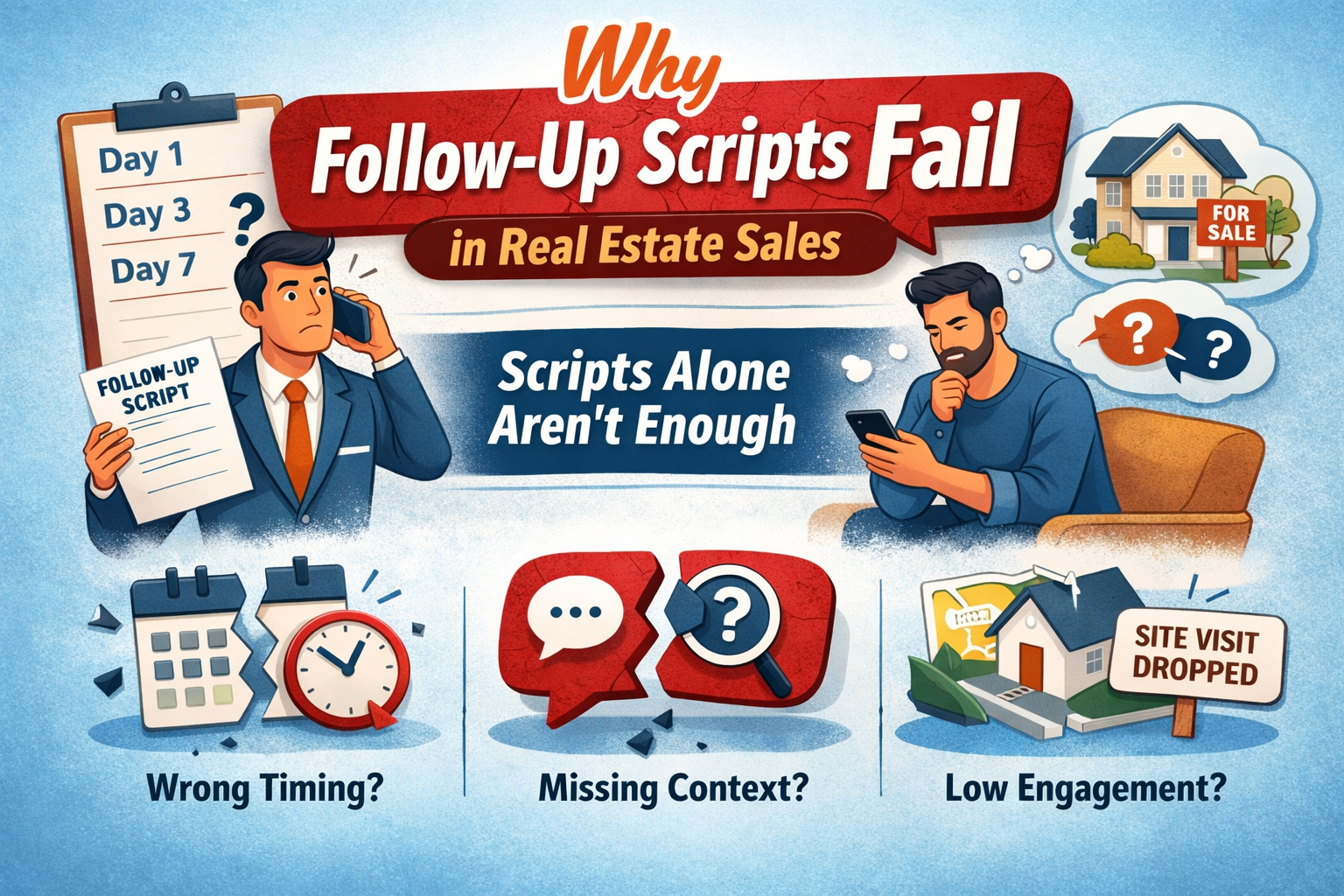
Why follow-up scripts fail in real estate sales
Most real estate teams don’t wing their follow-ups. They use scripts. They train agents. They standardise messaging. On paper, it looks disciplined. Yet despite having “good scripts”, response rates stay low. Buyers still go quiet. Site visits don’t increase meaningfully. When this happens, teams usually assume the script needs improvement — better words, better objections handling, better closing lines. But in practice, follow-up scripts fail for a different reason.
Why teams rely on scripts in the first place
Scripts exist for good reasons. They help:
- new team members get started faster
- maintain consistency across agents
- avoid awkward or unclear conversations
In high-volume environments, scripts also feel necessary. They bring order to chaos. The problem isn’t that scripts exist. It’s what teams expect scripts to solve.
What usually happens when scripts are used at scale
When scripts are rolled out across teams, a few patterns tend to appear.
Scripts sound right, but land wrong
Most follow-up scripts are polite, professional, and clear:
- “Just checking if you had a chance to review”
- “Any thoughts on the project we discussed?”
- “Let me know when you’re available”
Individually, there’s nothing wrong with these messages. But when buyers receive similar follow-ups from multiple projects, the words blur together. What sounds thoughtful to the sender feels generic to the receiver.
Scripts ignore where the buyer actually is
Scripts are usually designed around what the team wants next:
- confirmation
- a call
- a site visit
Buyers, meanwhile, may still be:
- comparing options
- clarifying pricing
- discussing internally
- unsure about their investment
When follow-ups don’t reflect that internal state, they feel premature even if they’re well-worded.
Scripts assume timing is fixed
Most scripts are tied to timelines:
- Day 1 follow-up
- Day 3 reminder
- Day 7 nudge
But buyer readiness doesn’t follow a calendar. A buyer might be ready to talk again in two hours — or in five days. Scripts that trigger purely on time ignore these differences, which is why they often miss the moment that actually matters.
Why scripts don’t improve site visit conversion
Site visits aren’t booked because a message was phrased well. They happen when: 1. the buyer feels understood 2. the timing feels natural 3. the next step feels helpful Scripts optimise language, but site visits depend on context. When scripts are used without knowing what the buyer has engaged with, they become interchangeable. And interchangeable messages are easy to ignore.
Where teams usually misinterpret the problem
When follow-ups fail, teams often respond by:
- rewriting scripts
- adding more variations
- training harder on objections
These changes improve delivery, but they don’t address the root issue. The core problem usually isn’t what is being said. It’s when and why it’s being said. Without visibility into buyer engagement, even the best script is just a guesswork.
What tends to work better than better scripts
Teams that see stronger engagement don’t abandon scripts completely. They change how scripts are used. A few patterns stand out:
- Context before copy - Messages work better when they reflect what the buyer has already seen or considered.
- Timing before wording - A simple message at the right moment beats a perfect script at the wrong one.
- Adaptation over repetition - Scripts perform better when they’re adjusted based on buyer behaviour, not repeated mechanically.
In other words, scripts work when they support judgment, not replace it.
Quick answer: why follow-up scripts fail in real estate sales
Follow-up scripts fail because they optimise wording without accounting for buyer timing and context. When messages don’t align with where the buyer is in their decision process, even well-written scripts feel generic and get ignored.
FAQs about follow-up scripts in real estate
Are follow-up scripts a bad idea?
No. Scripts are useful for consistency and training. They just don’t work well on their own without context.
Why don’t better scripts improve response rates?
Because response rates depend more on timing and relevance than on wording alone.
Should teams personalise every follow-up?
Not manually. What matters is that messages reflect buyer behaviour, not that every line is rewritten.
Do scripts hurt site visit conversion?
They can, if used mechanically. Scripts help when they support well-timed, relevant conversations.
What should teams focus on instead of scripts?
Understanding buyer readiness and engagement before deciding how and when to follow up.
Conclusion: scripts aren’t the problem — blind usage is
Scripts are tools. They’re not strategies. When scripts are used without context, they flatten conversations. When they’re used alongside an understanding of buyer behaviour, they become effective again. Follow-ups don’t fail because teams lack words. They fail because teams lack visibility. And visibility is what turns scripts into conversations that move forward.
If you’re curious how some real estate teams adapt follow-ups based on buyer engagement instead of relying only on scripts, you can explore how that approach works here