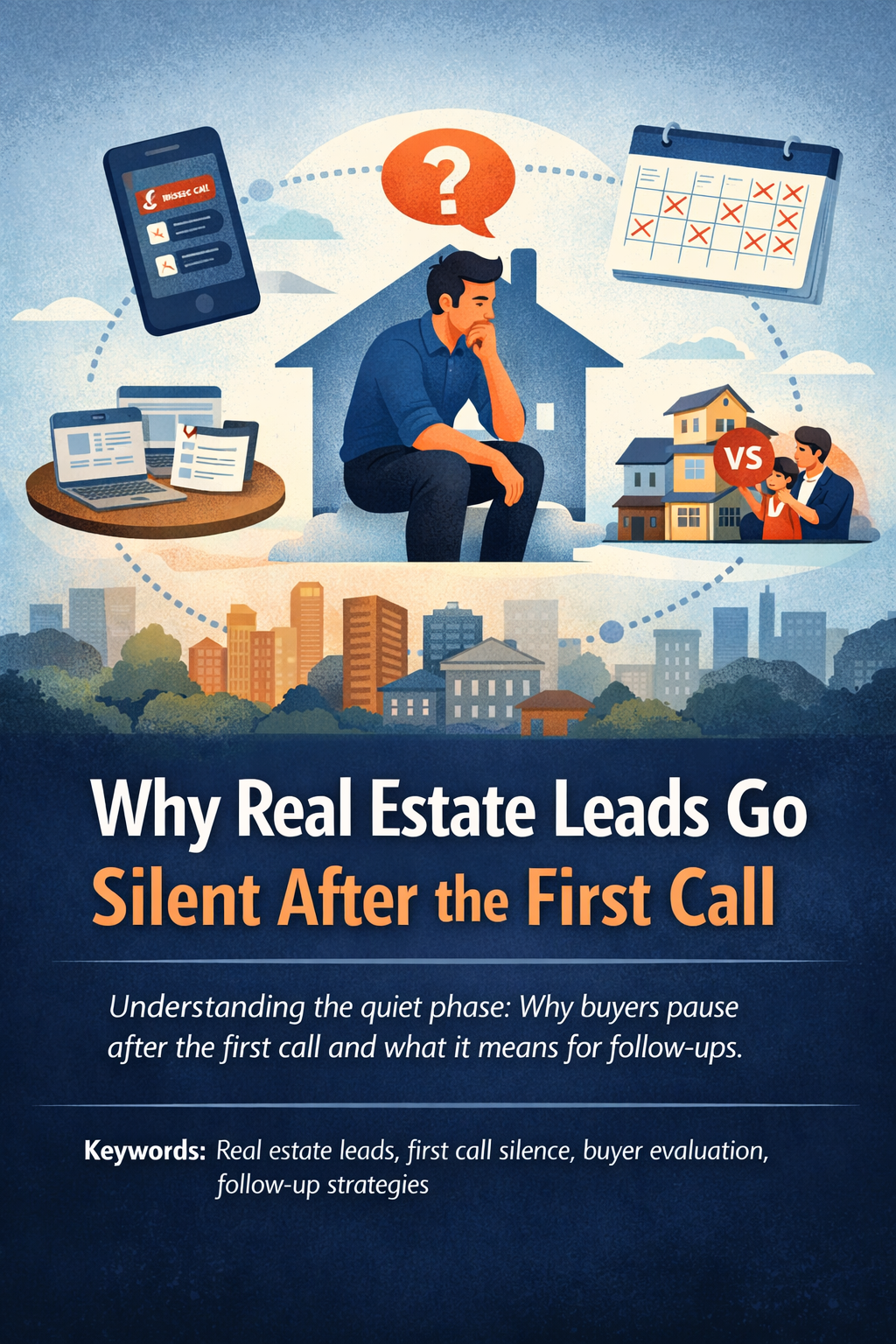
Why real estate leads go silent after the first call
The first call goes well. The buyer listens. They ask a couple of questions. They don’t say no. You hang up thinking: “This can move forward.” You follow up later — and the response never comes. Calls don’t get picked up. Messages don’t get acknowledged. The lead quietly slips into the “cold” bucket. If this keeps happening, it’s easy to feel like something is wrong with the leads. But when you look closely at how these first calls usually play out, silence after the call often has very little to do with lack of interest.
What teams usually assume after the first call
When a buyer goes silent after the first conversation, most teams assume one of two things:
- the buyer was just exploring
- the buyer didn’t like what they heard
Both feel reasonable. And both push the team to move on quickly. But across many real estate conversations, silence after the first call often shows up even when:
- pricing was within the budget range
- the project matched the buyer’s needs
- the conversation was polite and engaged
That’s usually a sign that something else is happening between the call and the follow-ups.
What typically happens after the first call ends
For buyers, the first call is rarely a decision-making moment. It’s more of an orientation. After the call, buyers often:
- replay parts of the conversation
- look up the project independently
- compare it with other available options
- discuss it with family or partners
During this phase, buyers aren’t avoiding the conversation. They’re stepping back to think. From the team’s side, this phase is largely invisible. Once the call ends, there’s no clear signal that shows whether the buyer is still evaluating or has already moved on. That gap is where silence usually begins.
Why leads go silent in practice
Silence after the first call is usually caused by a few recurring patterns. The call answers questions, but creates new ones A first call often clarifies basics — location, budget range, amenities, appreciation potential, etc. At the same time, it introduces new questions:
- “Is this better than the other option I saw?”
- “Does this actually fit my long-term plan?”
- “What’s the catch?”
These questions don’t always get voiced immediately. Buyers often want to think them through privately before responding again.
Follow-ups don’t match the buyer’s mental state
After the call, follow-ups usually focus on:
- checking availability for site visit
- pushing for the next step
- asking for confirmation
But the buyer may still be in comparison mode. When follow-ups don’t reflect that internal process, they feel out of sync. Not aggressive — just misaligned. And misalignment makes it easy for buyers to delay responding.
The momentum fades quietly
There’s usually a short window after the first call when the conversation still feels fresh. If nothing meaningful happens during that window, the context slowly fades — for both sides. Restarting the conversation later requires more effort, even if the buyer was initially interested. By the time teams follow up again, silence feels permanent — though it often started as temporary.
Why this silence is easy to misread
From the team’s perspective, the process looks complete:
- the call happened
- questions were properly answered
- next steps were mentioned
What’s missing is visibility into how the buyer engaged after the call. Without that visibility, silence gets interpreted as rejection. But in many cases, it’s simply the buyer thinking — without a clear reason to respond yet. This misunderstanding leads teams to either push too hard or disengage too early.
What tends to reduce silence after the first call
Teams that see better response rates after the first call usually don’t change their scripts dramatically. They change how they interpret silence. A few patterns tend to help:
- Treat the first call as the start, not the peak. Interest often grows after the call, not during it.
- Align follow-ups with evaluation, not confirmation. Buyers respond when messages reflect what they’re likely thinking about next.
- Pay attention to timing, not just effort. The right follow-up at the right moment matters more than repeated attempts.
These shifts don’t require harder selling. They require better awareness of where the buyer actually is.
Quick answer: why leads go silent after the first call
Real estate leads often go silent after the first call because they move into a private evaluation phase. When follow-ups don’t align with that phase, messages feel mistimed or irrelevant. The silence reflects unobserved consideration, not immediate disinterest.
FAQs about leads going silent after the first call
Why do buyers stop responding after the first call?
Because the first call usually triggers independent evaluation. Buyers pause communication while they compare options or think through decisions.
Does silence after the first call mean the buyer isn’t serious?
Not necessarily. In many cases, the buyer is still interested but not ready to engage again without clarity.
How soon should you follow up after the first call?
There’s no fixed rule. The right timing depends on how the buyer engages after the call, not just the passage of time.
Is pushing for the next step after the first call effective?
It often isn’t. Buyers respond better when follow-ups match their evaluation stage rather than forcing a decision.
Why do follow-ups feel ineffective after the first call?
Because they’re usually disconnected from what the buyer is processing internally at that point.
Conclusion: silence after the first call is often a thinking phase
When a buyer goes quiet after the first call, it’s tempting to assume the conversation is over. In reality, many buyers are still evaluating — just not out loud. Teams that treat silence as rejection lose momentum. Teams that understand it as a thinking phase stay aligned with the buyer’s journey. And alignment is what keeps conversations moving forward.
If you’re curious how some real estate teams understand what buyers engage with after the first call — instead of guessing — you can explore that approach here