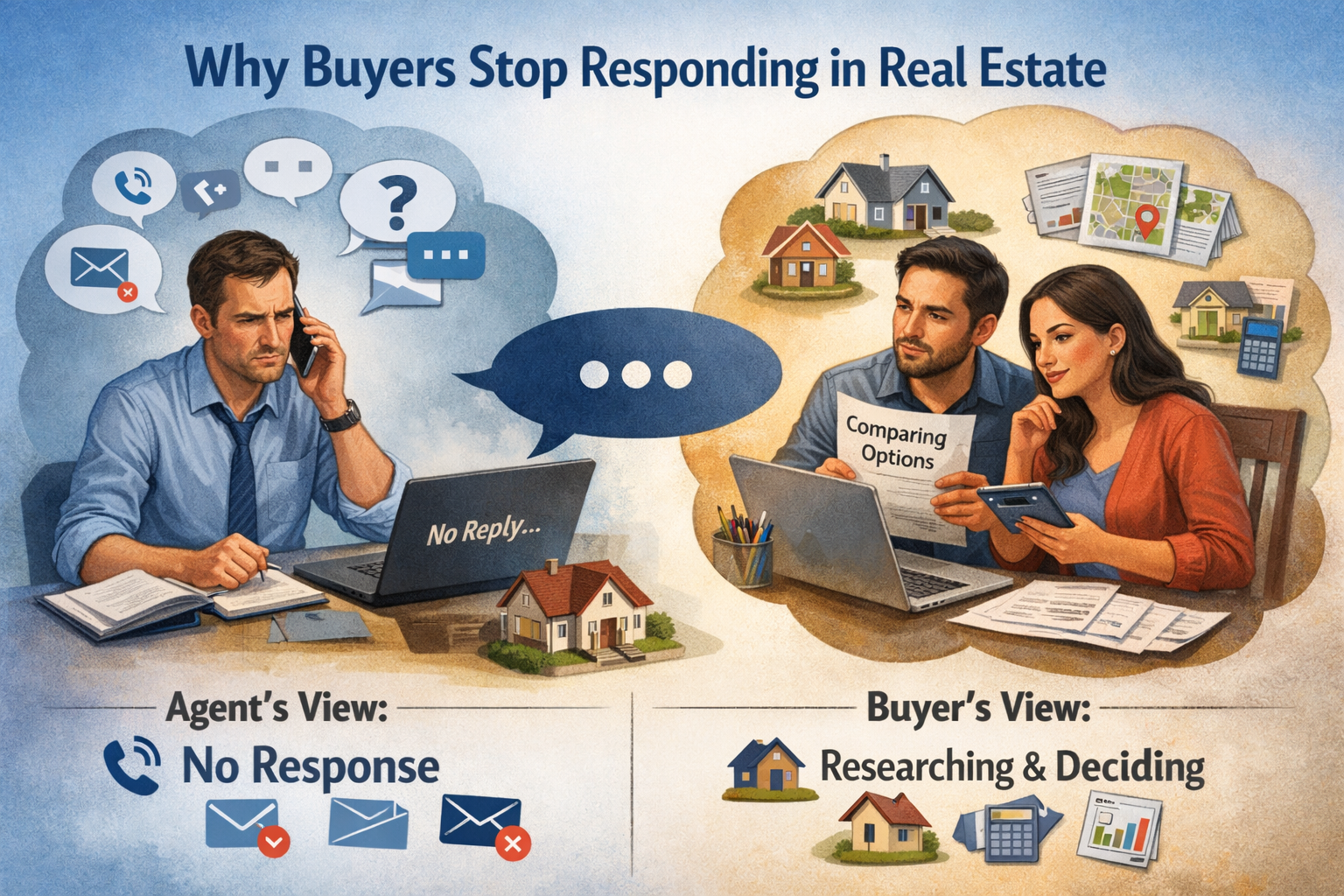
Why buyers stop responding after showing interest in real estate
A buyer asks for details. They sound interested on the call. You follow up once. Twice. Thrice. After that, the responses slow down. Calls don’t get picked. Messages stay unread or unanswered. If you’ve been in real estate sales for any amount of time, this situation will feel familiar. And when it keeps happening, it’s easy to assume the same thing every time - the buyer wasn’t serious. But when you look closely at how these conversations usually unfold, buyer silence often means something else.
What most teams assume when buyers go silent
When a buyer stops responding, the most natural conclusion is:
“They’ve lost interest.”
That assumption drives a lot of follow-up behaviour:
- calling more frequently
- sending more information
- trying different scripts
- pushing for a clearer response
Yet even with all that effort, response rates often don’t improve. In many teams, they actually decline over time. That’s usually a signal that the assumption itself deserves another look.
What often happens after a buyer shows interest
In many cases, buyer interest doesn’t disappear immediately after the first interaction. Instead, something quieter happens. Buyers start processing information on their own. They read messages when they have time. They compare options if they’re evaluating. They think through budgets, locations, and trade-offs. During this phase, they may not feel the need to reply, even though they’re still actively considering the purchase. From the team’s side, this phase is mostly invisible. And that’s where the gap begins.
Why buyers stop responding in practice
Buyer silence usually isn’t caused by one big mistake. It’s the result of a few small, common breakdowns that tend to happen together.
Buyers feel overloaded, not disinterested
After the initial conversation, buyers often receive:
- long whatsapp messages
- multiple pdf files/ brochures
- google maps link
- project images
- youtube videos
All of this information is well-intentioned. But without structure or guidance, it can quickly become overwhelming. When buyers feel overloaded, they don’t always say so. They pause. They postpone responding. And eventually, they go quiet. That silence is often a reaction to complexity not a loss of interest.
Follow-ups arrive without context
Most follow-up messages sound reasonable on their own:
- “Just checking in”
- “Any update?”
- “Let me know when you’re free”
The issue usually isn’t the wording. It’s that every buyer receives similar follow-ups, regardless of what they’ve actually engaged with. When follow-ups don’t reflect where a buyer is mentally, they can feel mistimed or generic — even if they’re polite. Over time, buyers stop responding not because they’re annoyed, but because the conversation no longer feels relevant.
The timing window quietly passes
Buyer curiosity tends to peak early. There’s usually a short window when a buyer is actively thinking about the property but hasn’t yet decided what to do next. If teams follow up after that window — without knowing what happened in between — the conversation often feels forced. At that point, even interested buyers are harder to re-engage.
Where this problem is usually misunderstood
When response rates drop, teams often look for visible causes:
- lead quality
- ad performance
- calling numbers
- scripts
Those are tangible and easy to measure. What’s harder to see is what buyers do between interactions. Without visibility into that middle phase, silence gets interpreted as disinterest — when it’s often unexpressed consideration. That misunderstanding leads teams to optimise the wrong parts of the process, while the real issue repeats itself.
What tends to improve buyer response over time
Teams that see better response rates usually don’t call more or push harder. They adjust how they think about follow-ups. A few patterns show up consistently:
- Timing matters more than frequency Following up at the right moment works better than following up often.
- Context matters more than scripts Buyers respond when messages reflect what they’re actually thinking about.
- Awareness matters more than volume Fewer, better-aligned conversations outperform a high number of blind calls.
None of this requires aggressive selling. It requires a better sense of when a buyer is ready to talk.
Quick answer: why buyers stop responding after showing interest
In many cases, buyers stop responding because they’re still processing information quietly. When teams follow up without visibility into this phase, messages can feel mistimed or generic. The result is silence — even when interest hasn’t fully disappeared.
FAQs about buyer silence in real estate sales
Why do buyers stop responding after showing interest?
Often because they’re comparing options or feeling overloaded with information. Silence usually reflects unspoken consideration, not immediate rejection.
Why do real estate leads go cold so quickly?
Leads appear cold when follow-ups don’t align with the buyer’s decision stage. Timing and relevance matter more than speed alone.
Is buyer silence a lead quality problem?
Not usually. In many cases, it’s a visibility issue — teams don’t know what buyers are engaging with after the first interaction.
How long should you wait before following up with a buyer?
There isn’t a fixed rule. The right moment depends on buyer behaviour, not a pre-defined delay.
Why do buyers ghost even after asking for details?
Buyers may go quiet when they receive too much information without guidance or when follow-ups don’t reflect their priorities.
Conclusion: Silence usually signals uncertainty, not rejection
Buyer silence is rarely about people being unreasonable or teams doing nothing. More often, it’s a sign that buyers are thinking and teams can’t see that thinking happening. When silence is treated as disinterest, follow-ups become pushy. When it’s treated as unseen consideration, follow-ups become more relevant. And relevance is what brings conversations back to life.
If you’re curious how some real estate teams get better visibility into buyer engagement before deciding who to follow up with, you can explore that approach here.